
The Road to Wigan Pier @ Welcome To The Johnsons

Updated: Jan 4

“If only the sandals and the pistachio-coloured shirts could be put in a pile and burnt, and every vegetarian, teetotaller and creeping Jesus sent home to Welwyn Garden City to do his yoga exercises quietly!” - George Orwell, The Road to Wigan Pier
I honestly wasn’t familiar with Orwell’s nonfiction work until my brother offhandedly mentioned The Road to Wigan Pier.
“Yeah, man, Wigan Pier is a good book,” he said.
“What’s it about?” I asked.
“A lot of things…” he responded, listlessly.
Despite his inability to explain it, something about the book stuck with me. Maybe it was the title — Wigan, a town in the north of England, doesn’t actually have a pier. Or maybe it was simply the idea of nonfiction by George Orwell. Either way, the guys in the book club seemed just as interested in digging into Orwell’s investigation of England’s working class.
Written in the 1930's, The Road to Wigan Pier explores the challenging reality for scores of Brits. The UK was in the midst of recovering from an enormous financial disaster, an emerging egomaniacal dictator threatening the sovereignty of neighboring Europoean countries and working class citizens feeling economically strained and politically disenfranchised.
"In a way it is even humiliating to watch coal-miners working. It raises in you a momentary doubt about your own status as an 'intellectual' and a superior person generally. For it is brought home to you, at least while you are watching, that it is only because miners sweat their guts out that superior persons can remain superior.” - George Orwell, The Road to Wigan Pier
The book is divided into two distinct halves. The first is a grounded investigation of working-class life in northern England, whereby daily survival is harrowingly bleak. For instance, Orwell details the struggle to find housing that is both affordable and fit for a family, the relentless math required to balance household budgets, the physical toll of manual labor in the coal mines, and the near absence of any meaningful social safety net.
"It means that Socialism, in the form in which it is now presented to us, has about it something inherently distasteful — something that drives away the very people who ought to be flocking to its support.” - George Orwell, The Road to Wigan Pier
The second half turns inward and asks a sharper question: if socialism is meant to serve working people, why does it so often fail to speak for them? Orwell approaches this through a sustained, devil’s-advocate critique, examining why fascism can appear more appealing, how ideological purity tests drive away potential allies, and how a strain of moral crankishness makes the left socially uninviting. He is especially critical of the way middle-class reformers come to dominate what was meant to be a worker-led movement.

"As for pubs, they are banished from the housing estates almost completely, and the few that remain are dismal sham-Tudor places fitted out by the big brewery companies and very expensive.” - George Orwell, The Road to Wigan Pier

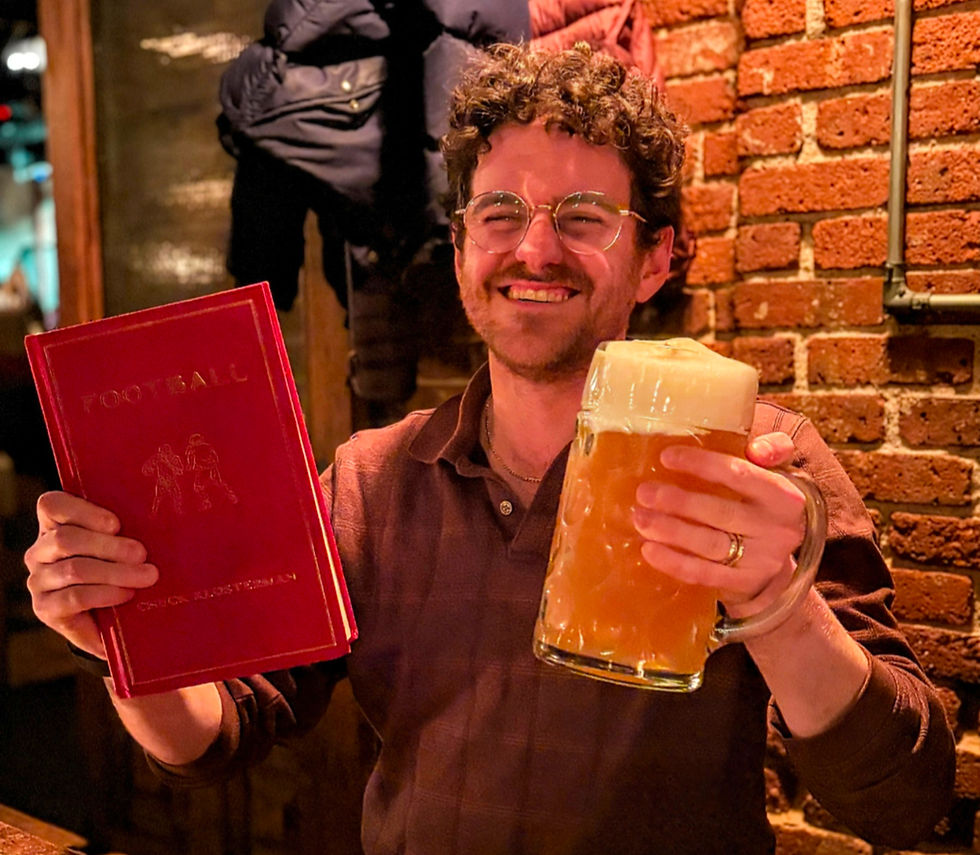
Welcome to the Johnson’s in the Lower East Side was put on our list as an almost ironic nod to Wigan Pier — for what could be more egalitarian than a $3 beer! Welcome to the Johnson’s is a true no-frills joint, offering just enough old-school familiarity for Gen Xers and elder millennials to briefly relive what NYC dive bars used to feel like.
I expected mostly everyone to hate the bar and find the book boring and esoteric. Instead we downed a lot of cheap beer and discussed the parallels between Orwell's Wigan Pier and much of what we're seeing play out in the world today. I expected the first part of the book to be the main topic because of its shocking descriptions of working class life, but we mostly lingered on Orwell's political critiques in the second half.

What resonated most was our discussion of the political left’s “purity tests” in 1930's England. Most of us consider ourselves very left-leaning, yet we recognized the familiar feeling of being treated as suspect by those who may be further left. As someone put it, "that pressure doesn’t pull people in. It pushes them to the right, where no one is policing their beliefs."
Shortly after book club wrapped, we indulged in a few too many ill-advised cocktails, swapped stories of pending wedding proposals, the trials of job hunting in 2025 and something I can't remember about EPA agents. We called it a night after scarfing down some late night slices.


Comments